
 The center
 Volver al menú principal
 Research
 Laboratories
 Transfer
 News
News Español

Multidirectional Dock Laboratory in Port Engineering and Maritime Engineering Channel
We drive innovation in maritime and port engineering through experimental research applied to port infrastructure and operations.

Port and Coastal Engineering
Port and maritime engineering is characterised by the involvement of a large number of variables with complex interrelationships; in many cases, these need to be analysed using physical model tests and field campaigns. The facilities and equipment available in the maritime and port engineering laboratory have led to the development of two key areas of research: the analysis and optimisation of port structures and the analysis of port operations.


Port and maritime engineering is characterised by the involvement of a large number of variables with complex interrelationships; in many cases, these need to be analysed using physical model tests and field campaigns. The facilities and equipment available in the maritime and port engineering laboratory have led to the development of two key areas of research: the analysis and optimisation of port structures and the analysis of port operations.


The analysis and optimisation of port structures is carried out using physical model tests at CITTEC, where there are four facilities available that can be adapted to each specific case. The parameters under study and analysis are: the stability of breakwaters, the components of breakwaters, the stability of transitions in breakwaters, wave-structure interaction phenomena, harbour turbulence and, finally, the structural and hydrodynamic behaviour of singular structures.
Port operational studies are carried out through field surveys using the equipment available in the Maritime and Port Engineering laboratory. Advances in science and computational algorithms are now making it possible to conduct field studies that take into account all the relevant variables. The studies are focused on the study and measurement of overtopping, as well as the operational performance of moored vessels, with the aim of developing machine learning-based tools to help with the decision-making process in port management.


It is a dock designed with a multidirectional wave-generation system, featuring a 25-metre frontage and a blade width of 0.44 metres, capable of generating waves of up to 20 centimetres and able to work with different draughts, and it also features 3D active absorption. Furthermore, the depth of the basin can be adapted to the bathymetric requirements of each project.
It is a wave channel with dimensions of 70 metres in length, 3 metres in width and 3 metres in height, featuring two independent and complementary wave-generation systems.
– Wave-generating paddle for shallow waters with a cross-section of [3×3] m, capable of generating waves of up to 0.7 m in water depths of up to 2 m.
– Deep-water wave-generating paddle designed to generate waves of less than 0.3 m in water depths of 2.25 m.
This ensures an optimal operating range within the channel, which can reproduce large waves in shallow water on a scale close to reality, as well as wave phenomena in deep water, while avoiding potential scale effects.
It is a wave channel with a width of 4 metres and a length of 33 metres, featuring a one-way wave-generation system capable of producing waves up to 30 cm high and accommodating different draughts. This allows us to adapt significantly to different climate scenarios that need to be analysed. It also features 2D active absorption.


- Data acquisition system with 128 channels and a sampling rate of 1.2 GS/s.
- Water level sensors, 0.7 m in length, which can be connected to the generator system itself in order to continuously record changes in water level.
- Piezoresistive sensors for the continuous measurement of pressure in ranges from 70/140 to 300 mbar. Designed for the NI data acquisition system.
- Water level sensors for measuring wave height, 1.3 m in length.
- 1-D load cells to measure stress in anchors.
- Point force load cells (Model 1250 – Vishay) to measure static and dynamic forces at a fixed point.
- Accelerometers to record the movement of models not fixed to the seabed.
- OPTITRACK system to record the movements of floating structures.
- High-resolution cameras.
- IMUs to record the 6 degrees of freedom of floating structures.
- Laser rangefinders to measure the movements of moored vessels.
- 50-tonne 1-D load cells to measure stress in anchors.
- Wave buoys to measure directional spectral data.
- Radar level sensors to monitor sea level and wave height.
- Current profiler and AWAC directional wave gauge from Nortek.
- Anemometers for measuring wind speed.
- High-resolution cameras.
- IoT infrastructure to automatically collect field data.

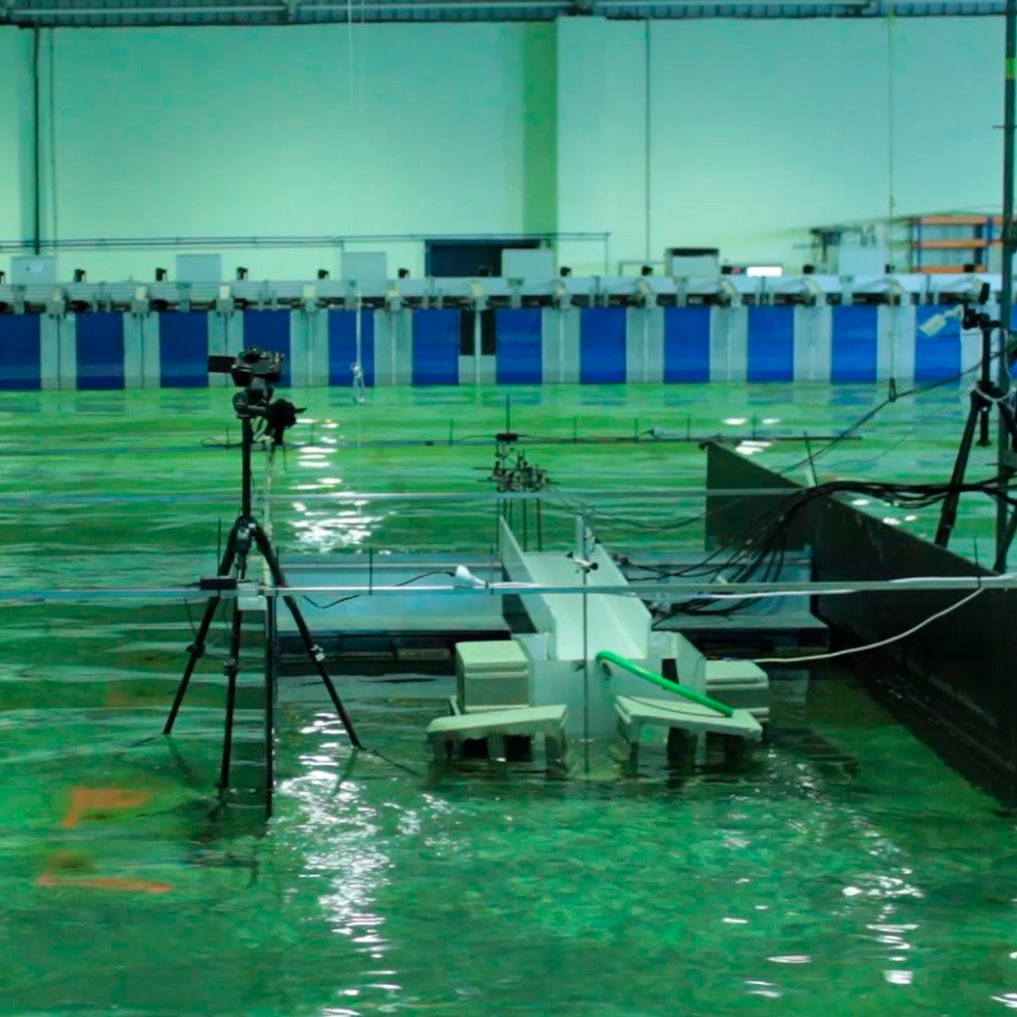
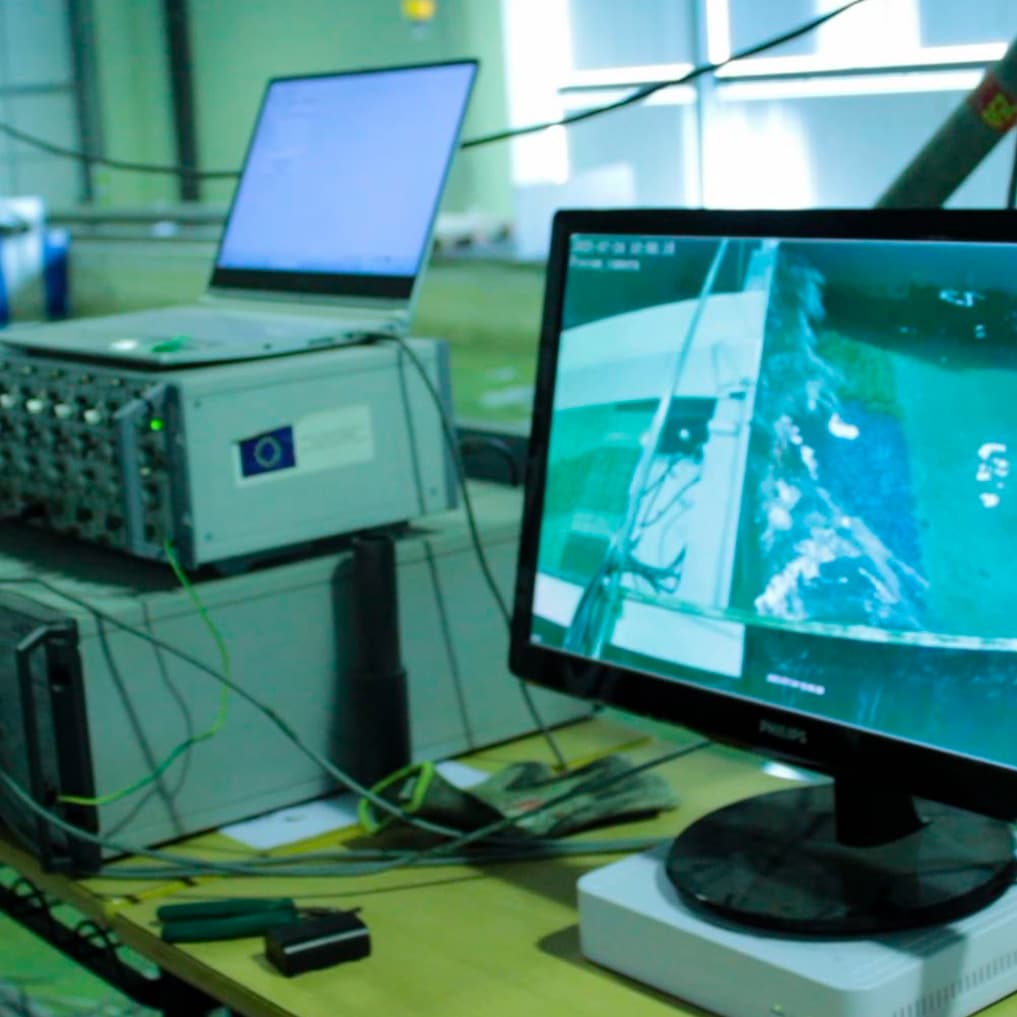
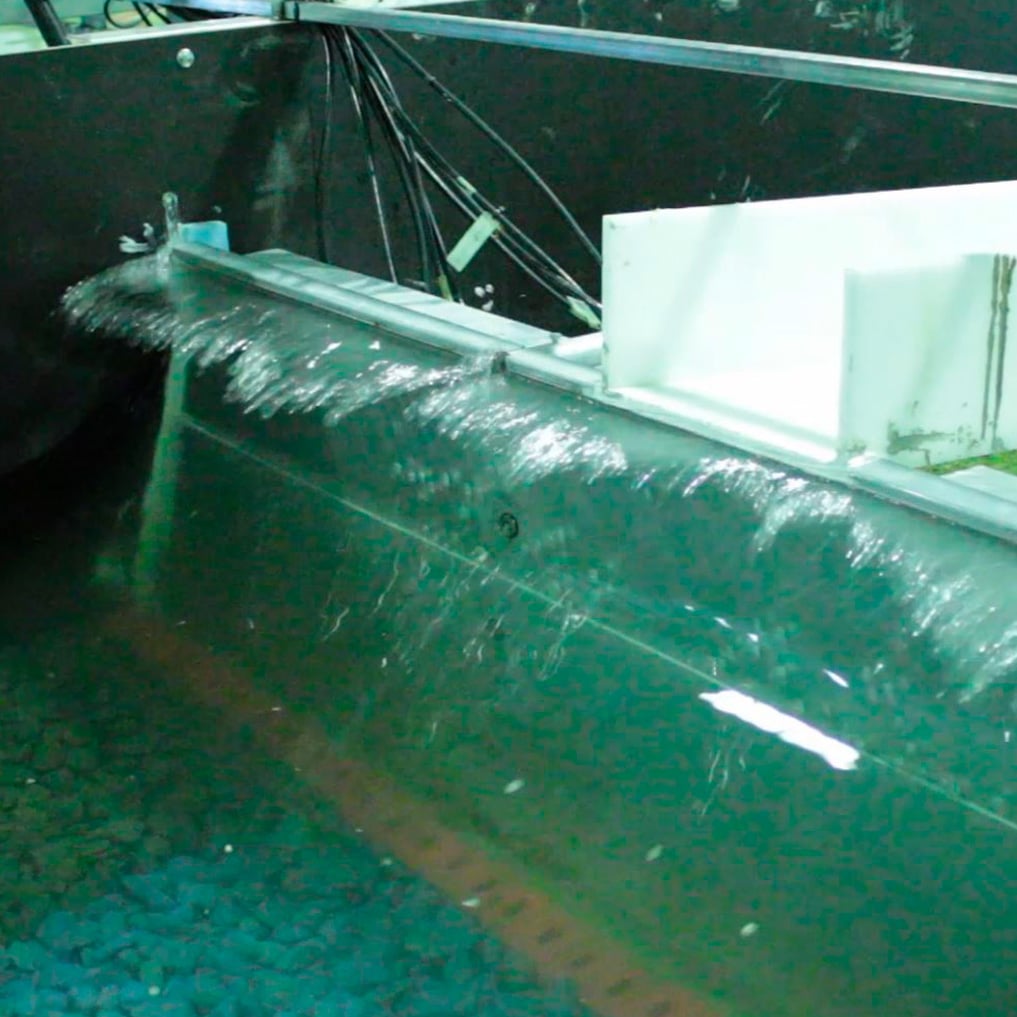

- Breakwaters at Palamós, Gran Tarajal, Playa Santiago and Corralejo (2019, 2020, 2021 and 2022)
- Port of Khatmat Malaha in Oman (2018)
- Port Fórum in Barcelona and Port d’Aro in Girona (2017 and 2014)
- Port of Bermeo (2015)
- The 1.3 km breakwater at the Outer Port of Punta Langosteira (2013)
- Marine Observatory from project Peiraos do Solpor (2024)
- New gastronomic balcony at Barcelona’s Port Olímpic (2023)
- Floating docks for the ports of Xufre, Baiona and Bozbük Marina (2011 and 2019)
- Wave energy devices (2023)
- Floating wind farms (2022)


 Contáctanos


